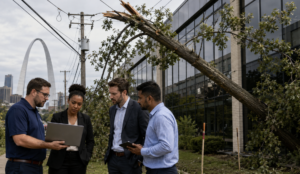
A mature tree can add shade, character, privacy, and value to a St. Louis property. It can also become the center of a serious disagreement when its branches stretch across a property line, its roots disturb a driveway, or a storm sends it crashing onto a neighboring building. These conflicts may begin outdoors, but many are now decided with evidence gathered through smartphones, security cameras, mapping platforms, cloud storage, and other forms of information technology.
That is why tree disputes have become a relevant topic for a St. Louis IT news audience. Property owners no longer have to rely entirely on memory, handwritten notes, or conflicting descriptions of what happened. Photographs can document the condition of a tree over time. Doorbell cameras can record the exact moment a limb falls. Digital property records can help identify the owner of the land where a tree is growing. Weather databases can establish when damaging winds passed through the region.
Technology does not replace professional legal, surveying, insurance, or arboricultural advice. It does, however, create a clearer record. When a neighbor’s tree crosses the line, that record can make the difference between an orderly solution and a long, expensive dispute. 🌳
The Property Line Is the Starting Point
The first issue in most tree disputes is the location of the tree in relation to the legal boundary. A fence, row of shrubs, retaining wall, or mowing pattern may appear to mark the division between two properties, but visible features do not always follow the recorded property line.
St. Louis residents can begin their research through the city’s official Geo St. Louis mapping resource. The platform combines parcel information from city departments and federal sources, giving the public access to useful geographic and property data. The city also provides an Address and Property Information Search that can display ownership, parcel, assessment, permit, and geographic information. These resources are valuable research tools, although they should not be treated as substitutes for a professional boundary survey.
When a tree trunk stands entirely on one person’s land, ownership may appear straightforward. The situation becomes more complicated when the trunk grows directly along a boundary or when years of growth make its original position difficult to determine. A licensed surveyor may need to locate the recorded line before either neighbor authorizes major trimming, root cutting, or removal.
Missouri courts have handled disputes in which neighboring property owners disagreed over the true location of a boundary. These cases demonstrate why assumptions, informal markers, and old neighborhood understandings may not settle the matter. Reliable records and professional measurements provide a stronger foundation than a line drawn on a phone screenshot.
Overhanging Branches Do Not Create Unlimited Cutting Rights
A branch extending over a fence can feel like an invitation to cut it back immediately. The safer approach is more deliberate. Property owners should identify the boundary, document the tree’s condition, review applicable local rules, and consider whether the proposed work could permanently damage the tree.
Missouri law provides serious consequences when someone cuts, injures, destroys, or removes a tree growing on land belonging to another person. Under Missouri Revised Statutes Section 537.340, a person who unlawfully damages certain trees or other property may be responsible for three times the value of the damaged material, along with costs. The application of the statute depends on the circumstances, which makes careful documentation and professional guidance especially important before substantial work begins.
Even when branches extend into a neighboring yard, cutting them recklessly can create liability if the work harms the trunk, destabilizes the tree, introduces disease, or causes the tree to die. Large limbs may also be under considerable tension. An improper cut can damage a roof, vehicle, fence, utility line, or person standing below.
A qualified arborist can examine the tree, identify structural weaknesses, and recommend pruning methods that protect both properties. The International Society of Arboriculture publishes professional tree-risk resources that support consistent evaluation and documentation. An arborist’s written report may become important evidence when neighbors, insurers, attorneys, or municipal officials need an independent assessment.
Smartphones Have Changed the Evidence
Modern tree disputes frequently begin with a phone. A homeowner notices a cracked limb, leaning trunk, exposed root system, or damaged fence and records it with photographs or video. That simple action can preserve details that disappear after a storm, cleanup, emergency removal, or seasonal change.
Digital images may contain dates, times, device information, and location data. A series of photographs can show whether a tree’s condition deteriorated gradually or changed suddenly. Text messages and emails can establish when one neighbor warned another about a dangerous limb. A tree-service estimate can show that professional help was recommended before damage occurred.
The National Institute of Standards and Technology’s digital evidence guidance explains that digital forensics involves retrieving, preserving, storing, and analyzing electronic data. Although a residential tree disagreement is different from a criminal investigation, the same basic principle applies: digital material is more useful when its origin and integrity can be established.
Homeowners should retain original files instead of relying only on edited screenshots or social-media copies. Images sent through messaging applications may be compressed or stripped of useful metadata. Original photographs, full email threads, camera footage, invoices, inspection reports, and backup copies create a more reliable timeline.
Cloud storage can protect evidence if a phone is damaged or replaced. Files should be organized in folders with clear names and dates. A short written log can connect each photograph to a specific event, such as the first observation of a crack, a conversation with a neighbor, an arborist’s visit, or the date of a severe storm. 📱
Security Cameras Can Establish What Actually Happened
Doorbell cameras and exterior security systems have become common across the St. Louis region. Their recordings can be valuable when a tree limb falls overnight, workers enter a disputed area, or one neighbor alleges that the other caused damage.
Video may show whether a branch fell naturally, broke during high winds, or came down while someone was cutting it. Footage may also establish the time of the event and reveal the direction of the fall. Nearby businesses and other homeowners may have cameras that captured the incident from a different angle.
Recording availability is often limited. Many systems automatically overwrite older footage unless the owner saves a clip. Anyone involved in a property-damage incident should preserve relevant recordings promptly, retain the original file when possible, and note the camera’s location and time settings.
Responsible use matters. Cameras should be positioned for legitimate property-security purposes and used in a manner consistent with applicable privacy laws. Posting an argument or damaging incident online may escalate the conflict and complicate settlement. Evidence is usually more useful when it is preserved privately and shared with the appropriate professionals.
Weather Data Can Separate Neglect From a Sudden Event
St. Louis experiences thunderstorms, heavy rain, strong winds, ice, and occasional tornadoes. These conditions can weaken roots, split trunks, and bring down limbs that previously appeared stable. Weather records can help determine whether damage followed an unusual event or resulted from a condition that had been visible for months.
The National Oceanic and Atmospheric Administration’s Missouri disaster data documents major severe-weather and flooding events affecting the state, including events that have damaged homes, businesses, vehicles, and infrastructure around St. Louis. NOAA also maintains historical storm information that can support insurance investigations, property claims, and professional evaluations.
A timestamped camera recording paired with official weather data can create a strong timeline. For example, video may show a limb falling at 8:17 p.m., while weather records document damaging winds in the area at the same time. That combination is more informative than a general statement that the night was stormy.
Weather evidence does not automatically determine responsibility. The condition of the tree before the event still matters. Photographs showing dead limbs, decay, fungal growth, a hollow trunk, or a long-standing lean may become relevant. An arborist is better positioned to explain whether the failure was predictable, storm-related, or caused by a combination of factors.
Drones and Digital Inspections Offer a New Perspective
Some tree problems are difficult to see from the ground. A branch may be split near the crown, a cavity may face away from the house, or a roof may have sustained damage that is unsafe to inspect with a ladder. Drone photography can capture high-resolution images from angles that were once difficult or expensive to obtain.
Tree companies, roof inspectors, insurance professionals, surveyors, and property managers increasingly use aerial technology to document conditions. Drone images can reveal the relationship between a tree and nearby structures, utility lines, fences, garages, and neighboring parcels.
Drone footage should still be interpreted by a qualified professional. A photograph may reveal a visible crack, but it does not necessarily show the full extent of internal decay or root failure. Flight operations must also comply with federal aviation requirements and respect privacy and property concerns.
Aerial imagery can be particularly helpful after a widespread storm, when fallen limbs have affected multiple properties and physical access is limited. The images provide an overview before cleanup changes the scene.
When Roots Create Damage Below the Surface
Branches are visible, but roots often create the more complicated dispute. Tree roots may lift pavement, disturb a retaining wall, enter a sewer line, or contribute to cracks in hardscaping. Determining the cause requires more than pointing to the nearest tree.
Plumbers can use sewer cameras to inspect underground lines and record the location of root intrusion. Engineers can document movement in walls, slabs, and foundations. Ground-penetrating radar and specialized root-detection tools may help professionals study below-ground conditions without immediately excavating the area.
Digital inspection reports are especially useful because they preserve measurements, video, diagrams, and professional conclusions in one file. When several possible causes exist, a detailed report helps separate observation from assumption.
Aggressively cutting roots can destabilize a tree. A tree that remains standing after major root removal may become more vulnerable to wind and saturated soil. Property owners should avoid turning a drainage or pavement problem into a falling-tree hazard.
Tree Disputes Can Affect Business Technology
A falling tree does not have to land on a house to cause serious disruption. It may damage a utility line, fiber connection, exterior security system, satellite dish, rooftop equipment, or underground conduit. For a St. Louis business, the result can include lost internet access, interrupted payment processing, inaccessible cloud applications, and disabled security cameras.
Companies should include tree exposure in their technology risk planning. Servers and network equipment should have battery backup, critical data should be stored securely off-site, and internet-dependent businesses should consider a secondary connection. Exterior cables, cameras, wireless bridges, generators, and telecommunications equipment should be included in property inspections.
The history and development of St. Louis have produced a varied mix of older neighborhoods, mature trees, historic buildings, dense commercial corridors, and modern technology infrastructure. That combination creates situations in which a single fallen limb can affect several properties or services at once.
Businesses should also preserve outage notifications, repair invoices, security footage, equipment logs, and lost-sales records after an incident. These materials may be relevant to an insurance claim or legal review. Technical evidence can help demonstrate exactly when systems failed and how long operations were interrupted.
Communication Still Prevents Many Disputes
Technology provides evidence, but communication often prevents the conflict from reaching that stage. A calm written notice gives the tree owner an opportunity to arrange an inspection or trimming. The message should describe the observable condition, include clear photographs, and avoid accusations that cannot yet be supported.
A conversation followed by an email creates both a human connection and a written record. The email can summarize what was discussed, identify any agreed next steps, and establish a reasonable timeline. Certified mail may be appropriate when the condition appears dangerous or previous attempts at communication have been ignored.
Neighboring property owners may also agree to share the cost of an arborist, survey, or preventive pruning. A neutral professional can often replace suspicion with practical information. Mediation may provide another path when communication has broken down but both sides want to avoid litigation.
For property owners seeking local information, professional evaluation, and guidance about Tree Law St. Louis, early action is usually more productive than waiting for a limb to fall or a disagreement to intensify.
Conclusion
When a neighbor’s tree crosses the line, the dispute involves more than branches and fences. Property records, GIS maps, smartphones, security cameras, weather databases, drones, sewer cameras, cloud backups, and digital communications can all influence how the facts are understood.
The most effective approach combines technology with qualified human judgment. Surveyors establish boundaries. Arborists evaluate tree health and risk. Engineers and contractors assess structural damage. Insurers review coverage. Attorneys explain legal rights and responsibilities based on the specific facts.
St. Louis property owners and businesses should document visible concerns, preserve original digital files, communicate respectfully, and seek professional advice before cutting major limbs or roots. Technology cannot guarantee that every neighbor will agree, but it can replace uncertain memories with a dependable record. When trees, property lines, and valuable infrastructure meet, good information matters.