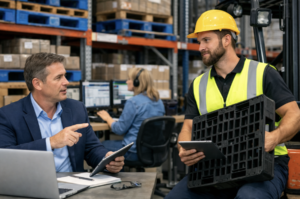
Rackable pallets companies operate in a business environment where precision, timing, durability, and consistency all matter. Whether the company manufactures plastic pallets, distributes industrial storage solutions, or serves warehousing and logistics clients, the expectations are high. Customers want dependable inventory, accurate order fulfillment, fast communication, and a supplier that can keep up with changing supply chain demands. That is exactly why an IT consultant is no longer a luxury for a rackable pallets company. It is a smart business decision.
An IT consultant helps connect technology to the real goals of the business. In practical terms, that means stronger cybersecurity, better inventory visibility, smoother operations, less downtime, more reliable communication between departments, and systems that are designed to support growth instead of slowing it down. Information technology consulting is centered on helping organizations use technology more effectively to reach business objectives, and that matters deeply for companies that rely on operations, logistics, vendor coordination, and customer trust every day.
An IT Consultant Brings Strategy to Operations
Many rackable pallets companies start out by building technology one piece at a time. A basic inventory system gets added first. Then accounting software. Then a customer database. Then warehouse tools, shipping integrations, email platforms, and remote access solutions. Over time, the company may end up with disconnected systems that do not communicate well with one another. The result is friction. Staff members enter the same data more than once. Reports do not match. Inventory counts become harder to trust. Leadership loses visibility into what is really happening in the business.
An IT consultant steps in with a broader view. Instead of looking at one software problem in isolation, a consultant evaluates how the company runs from end to end. That includes procurement, production planning, order management, warehouse workflows, invoicing, customer communication, security, and long-term scalability. Digital transformation is not just about buying more tools. It is about using technology to modernize processes, improve performance, and support ongoing innovation across the company. That broader business-first view is exactly what strong consulting brings to the table. IBM’s explanation of digital transformation and McKinsey’s overview of digital transformation both frame transformation as rewiring how a business operates so technology creates measurable value rather than scattered complexity.
For a rackable pallets company, this can mean aligning software and infrastructure with how products actually move through the business. It can mean better lot tracking, improved reorder planning, clearer production scheduling, and faster access to sales and operations data. When technology starts supporting the business instead of confusing it, decision-making becomes stronger.
Cybersecurity Is a Business Issue, Not Just a Technical One
A rackable pallets company may not think of itself as a prime cyber target, but that mindset is risky. Manufacturers, distributors, and logistics-driven businesses increasingly depend on email systems, vendor portals, cloud applications, invoicing platforms, shipping systems, and connected equipment. Any weak point can become an entry point. A ransomware event, phishing breach, or compromised vendor account can create delays, lost revenue, damaged relationships, and reputational harm.
An IT consultant helps the company move from reactive security to structured protection. The NIST Cybersecurity Framework 2.0 describes a widely used framework for helping organizations understand, assess, prioritize, and communicate cybersecurity risk. Meanwhile, CISA’s Cross-Sector Cybersecurity Performance Goals outline voluntary, high-impact baseline actions organizations can take to improve security posture.
That matters because pallet companies often handle sensitive business data even if they are not in a glamorous industry. Customer pricing, supplier contracts, freight records, employee data, banking details, and internal forecasts all have value. An IT consultant can help build appropriate safeguards such as access controls, backup strategy, patch management, endpoint protection, vendor risk review, and incident response planning. This reduces the chances that one technical mistake turns into an operational crisis.
In a business where trust is earned through reliability, cybersecurity directly affects credibility. Clients want to know their vendor is stable, secure, and dependable. A company that takes technology governance seriously sends a strong signal to customers and partners alike.
Downtime Costs More Than Most Companies Realize
In a rackable pallets business, downtime ripples through everything. If the warehouse system is unavailable, shipping may slow down. If order information is not syncing, customer service cannot give accurate answers. If remote access fails, managers lose visibility. If backups are weak, recovery after a disruption becomes expensive and chaotic. Even short interruptions can affect labor efficiency, customer confidence, and delivery commitments.
An IT consultant helps identify hidden weak points before they become expensive failures. That includes aging hardware, unreliable networks, poor software integrations, unsupported systems, and the lack of a clear disaster recovery plan. Many companies do not realize how exposed they are until a server fails, a user clicks the wrong link, or a software vendor changes an integration. By then, the cost is far greater than the cost of proactive planning.
This is especially important for businesses that want to grow. Growth magnifies weaknesses. A process that works for a smaller operation often breaks once order volume, customer count, locations, or team size increases. An IT consultant helps build the right foundation early so growth does not become a source of instability.
Better Data Creates Better Inventory and Supply Chain Decisions
Rackable pallets companies live and die by operational clarity. If inventory data is wrong, sales teams may overpromise. If production timelines are unclear, customers may wait too long. If procurement is not aligned with actual demand, capital gets tied up in the wrong materials or finished stock. Technology problems turn into business problems quickly in this type of environment.
An IT consultant helps a company improve how data is collected, shared, and used. That can include integrating warehouse and ERP systems more effectively, improving dashboards, cleaning up reporting structures, or designing workflows that reduce manual entry. The goal is not more data for the sake of data. The goal is useful information that helps leadership make smarter decisions.
Consultants also help companies identify where automation makes sense. That might include automated inventory alerts, order routing, vendor communication triggers, or more accurate forecasting tied to historical demand. Better information allows the company to manage working capital more efficiently, reduce avoidable waste, and respond faster to customer needs. In a competitive industrial market, those advantages add up.
An IT Consultant Helps Leadership Make Smarter Technology Investments
One of the most overlooked benefits of working with an IT consultant is better spending. Many companies overspend on the wrong systems, underspend on critical infrastructure, or continue paying for tools that no longer fit the business. Others avoid investment too long, which creates bottlenecks that quietly drain productivity.
A good consultant brings objectivity. They can assess whether the business truly needs a new platform, whether a current system can be optimized, or whether the problem is really process design rather than software. That outside perspective protects the company from emotional or rushed decisions. It also helps leadership tie technology investments back to practical business outcomes such as uptime, labor efficiency, customer response time, security, reporting, and scale.
For a rackable pallets company, that could mean choosing the right cloud strategy, upgrading outdated infrastructure, improving connectivity across facilities, or selecting tools that support both warehouse operations and customer-facing functions. This is where consulting becomes deeply valuable. It is not about selling technology for the sake of appearance. It is about building an environment where the company runs better and stronger.
Modern Security and Access Control Matter More Than Ever
Today’s business environment is more mobile, more connected, and more exposed than it used to be. Employees may access systems from different devices and locations. Vendors may need limited portal access. Cloud applications may be storing important operational data outside the traditional office network. That is why modern security models matter.
Microsoft’s Zero Trust overview explains that Zero Trust is a security strategy built around verifying access requests rather than assuming trust based on network location alone. For a rackable pallets company, this matters because business systems are no longer neatly contained in one office. Email, cloud storage, inventory applications, and remote admin access all increase exposure if controls are weak.
An IT consultant can help implement smarter access policies, stronger identity protection, multi-factor authentication, device standards, and role-based permissions. These are not abstract technical upgrades. They directly reduce the likelihood that one stolen password or unmanaged laptop leads to a larger business disruption. This is how a company protects operations while still allowing the team to work efficiently.
Technology Leadership Without the Cost of a Full Internal Team
Not every rackable pallets company needs a large internal IT department. Many growing businesses need guidance more than they need a full payroll expansion. That is another reason an IT consultant makes sense. The company gets access to strategic thinking, outside experience, and focused recommendations without immediately taking on the fixed cost of a senior in-house technology leader.
This can be particularly valuable during periods of transition. Maybe the company is expanding locations. Maybe it is upgrading systems. Maybe it is trying to improve security after a near miss. Maybe leadership knows the current setup is no longer enough but does not yet know the best path forward. A consultant helps create clarity. They can assess the environment, prioritize next steps, and provide a roadmap that fits the business instead of overwhelming it.
That kind of guidance helps owners and executives stay focused on serving customers, growing revenue, and strengthening the business rather than getting buried in technical confusion.
Conclusion
A rackable pallets company needs an IT consultant because modern business performance depends on more than product quality alone. It depends on secure systems, reliable operations, connected data, stable infrastructure, and smart planning. An IT consultant helps turn technology from a patchwork expense into a strategic asset. That means fewer disruptions, stronger protection, better decisions, and a more scalable company.
In an industry where reliability matters, technology should never be an afterthought. It should be part of the company’s strength. When a rackable pallets business brings in the right IT consultant, it gains more than technical support. It gains structure, visibility, protection, and a better path forward. That is the kind of investment that supports long-term trust, stronger authority, and a healthier digital foundation for future growth.